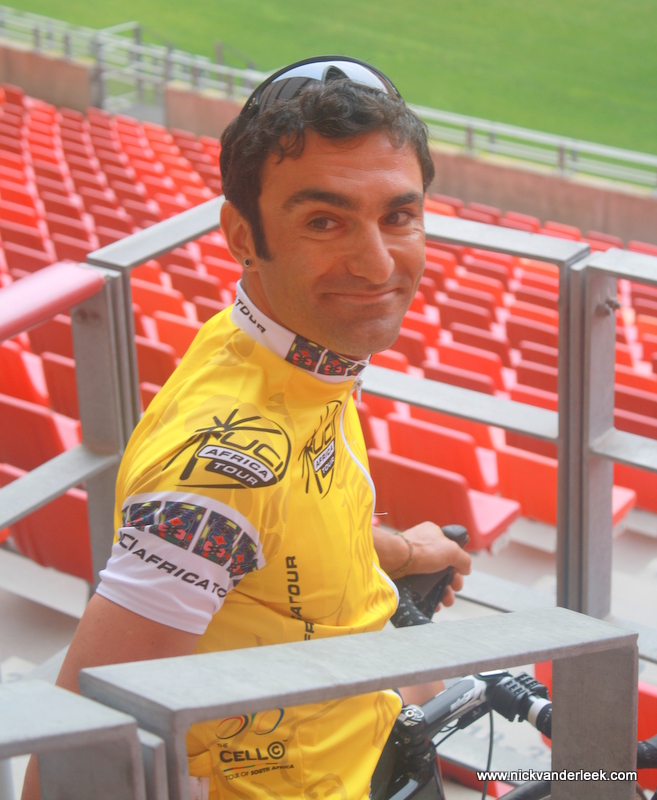
Commissioned by Men's Health, 2011
Uncommon Cunnama
PE-based Ironman triathlete James Cunnama is the top athlete of the world’s most successful Ironman team, TeamTBB. Cunnama can run the tail off a jack rabbit. In Ohio [and another Ironman title] he ran a 2h43 marathon.
“My ultimate goal,” Cunnama says, “is to win Ironman World Champs in Kona, Hawaii. When I set that goal, a few years ago it was... ambitious! These days it is becoming more realistic.”
The finishing time in Hawaii this year of new world champ Chris McCormack was 8 hours 10 minutes. Cunnama finished Ironman Austria in 8 hours 16 minutes. In Ironman Triathlon Cunnama is one of the world’s best. James shares a few world class insights on how to get into peak physical condition. – by Nick van der Leek
Consistency
The most important thing for all athletes, of any level, is consistency. Your body will adapt to any regularly imposed stress, and most people far under-estimate what their body is capable of adapting to! But similarly, your body will only maintain a level it needs to, and no higher, so any sustained breaks in training mean you go backwards. You need the occasional mental break, especially training the way I do, but I aim to build, week on week, month on month, year on year, slowly but consistently building up my body's ability to handle what it needs to. And I plan to keep building this until I can handle the training needed to be the best in the world!
Community
Racing in South Africa is always special for me. Obviously knowing the conditions and course helps, but having family and friends around changes the race from 'work' to a special experience. The top race for me is of course Spec-Savers Ironman South Africa. It is in my home town, and it was where it all started for me. In 2005 and 2006 I volunteered at this race and was hooked. This was where I first found out what Ironman was, and the dream was born. Other than that, the shorter Ironman 70.3 Buffalo City is also a great event.
Daily Grind
My general day consists of 2-3 sessions, for a total of 4-8hrs of training daily. With triathlon we get to mix it up with three disciplines, so it never gets boring. But sometimes it is hard to get the sessions in when travelling and moving around. Again though, you can always do something, like a run, which you can do anywhere!
Sacrifices
There have been many sacrifices to get where I am now, and no doubt there will be many more. Triathlon is not exactly a mainstream sport, so the money, although there for the top guys, does not go very deep in the Pro ranks. The last three years I have been 'in the red' financially and only now I am getting out of that 'living hand-to-mouth' situation. But that is only one side of the sacrifices. I spend 9 or more months away from South Africa every year. While that may seem exciting and glamorous, that amount of time away from home takes its toll on family, friends and makes relationships all but impossible. It is a very unsettled lifestyle. But I think it is all worthwhile. Everyone needs to make sacrifices for their goals. The bigger the goals, the bigger the sacrifices...
Dedication
My Mom was up at 5am every day, year round, to run with a local group, called The Pukers who trained for everything from cross-country to Comrades. So I decided to join her. But it was up to me. My Mom would pop her head in my room at 5am, say "James, time to run." close the door and go get ready herself. I could, and a few times did, just roll over and go to back sleep. And my Mom would not come wake me again, she would just leave. I soon learned that starting the day with a run was way better than starting it with an extra hour of sleep. To this day I still have no problem getting up immediately my alarm goes off.
To win, to realise his dream of becoming a world Ironman champion, Cunnama needs to shave one or two minutes off his marathon. “My entire family is doing a half-marathon in the Winelands this November.” With running in his genes, that world championship title is looking more and more like natural progression.
Five fitness tips:
1. Consistency - Your body will adapt to any regularly imposed stress.
2. Mix it up - there are an unlimited number of activities which will build fitness, so don't get stuck in the rut of doing the same thing day in and day out. And the body responds well to varied challenges, making you stronger in your goal sport
3. Set goals - 'getting fit' is a terrible goal, because you never get there! Pick an event or challenge to aim for.
4. Train, don't strain - Fitness is not built in one big session, but over lots of smaller sessions. Smashing yourself in one session may feel like it must be helping, but it more than likely meant a long recovery period, which actually decreased your fitness. Save the big efforts for the competitions!
5. Keep it fun - If building your fitness is not fun, you will not be consistent, and that will cost you, as described in tip no.1.
On Tissink
Raynard [5th at 2010 World Ironman Championships] and I are good friends. We don't train together much, but there is no animosity between us. Of course there is also no love lost on race day! We have raced each other a lot, but always seem to have the result decided by external factors, like punctures or such. Last year we both raced back to back Challenge events (half-IM) and he beat me one and I beat him the other. But we haven't both finished the same race since... I look forward to racing him again!
Wednesday, April 6, 2011
Thursday, March 17, 2011
Wednesday, March 9, 2011
PERSPECTIVE: Live while you're alive
Published in City Press.
Free spirited living is exciting and joy filled. Aron Ralston’s sudden loss of that freedom is compelling because through his narrative we revisit our own motives for living the way we do. How then can we inspire ourselves back towards passionate and cheerful living?
Aron Ralston’s story is so much more than just a story about cutting off an arm. Although this terrible scene is a vital element of an incredible story, it is not the most important. And in this there is an interesting life lesson, and the reason 127 Hours is Oscar material. On this point director Danny Boyle says, “What gets him out of there is not power…but the change that comes from within him.”
1. Check in to the Real World
What is it then that compels us to survive; what is the elixir for living in the modern age? Living in the real world is a good place to start. Ralston and another famous vagabond, Chris McCandless [Into the Wild] spent most of their time outside, alone, feeling the wind and the rain, and experiencing the magical sweep of the world firsthand. Reality is exhilarating. Contrivances, distractions and escapism are poor substitutes for real life.
2. Find your own unique magic
Nor should we just react to life. What really motivates us is something else. The thing that finally got Aron Ralston to start amputating his arm was not pain, or dehydration, or the thought of missing his sister’s wedding, or visions of family and his friends, or missing out on a party, or suffering or even the thought of death. None of these inspired him enough to save his life; it was the image, imagined, of an unborn son that did it. In 2003 Ralston didn’t have a girlfriend, nor was he married or a father. Yet it was that image of the little boy that galvanised a resolve that was already there…into what Ralston calls his ‘epiphany’, one that that made the amputation act, with a blunt knife, a life saving choice.
3. Don’t wait, live now
Aron Ralston’s alter ego is arguably Chris McCandless. Director Danny Boyle points out the key difference between Ralston and McCandless: “When he does go to the wild he doesn’t just sit there he …races through it with his earphones on and he’s fucking timing himself to try to get through it quicker than anyone else and try to climb higher than anyone else. It’s this restlessness about him that’s very urban.”
While McCandless succeeded in his goal of surviving for 100 days in Alaska in winter, he ate toxic seeds whilst waiting for spring flood waters to subside, and finally died of starvation. McCandlesss had been outdoors for over three months and in a far more weakened condition than Ralston. Even so, McCandless was much closer to highways and human settlements than Ralston was. McCandless waited to be saved and finally died. Survival lesson three: it’s up to you – do what you can to save yourself, don’t wait for help that might not come.
4. Find Out For Yourself
Amputating his own arm has caused cinema audiences to faint. Presumably this is more horrifying than having someone else do it. To make sure things happen in your own life, Do It Yourself. That’s what a lifetime should be, doing this and doing that, not wait and see, wishful thinking and endless hope without action. And to test the truth of what life is, you have to be brave and find out firsthand.
5. Entitlement = Misery/Humility = Happiness
The underlying theme to 127 Hours is humility, something conspicuously absent in modern living. And with humility comes grace, something the writer Cormac McCarthy [The Road] says is “the power that heals men, and brings them to safety long after all other resources are exhausted.” Once he’d disconnected himself from the rock Ralston knew he had won his life back. It was his humility that also imbued him with a sense of gratitude for the whole experience.
Instead of focussing on the cost of living, find the joy of living. For each of us, the answer is different, but it lies buried in the narrative we make for ourselves, and sometimes, in the story we can still imagine for ourselves. Then all that remains is to have the courage to go out and live.
Five Kick-starters for Everyday Happy Living
- Give yourself more space to be happy
- Be true to yourself [live an authentic life, find the magic inside you that inspires you]
- Show more emotion
- Work less
- Put more effort into your relationships
Thursday, March 3, 2011
PEOPLE: Kristian House brings home South Africa’s Golden Lion – by Nick van der Leek
Published in March 3 Cycling Weekly
Rapha Condor-Sharp’s Kristian House won the inaugural Tour of South Africa that ended in Paarl, near Cape Town, on Saturday. His margin over South African Johan Rabie [BONITAS] was a comfortable 2’09”. Daryl Impey [MTN Qhubeka], who previously rode for Armstrong’s Radioshack finished third in 2’11”.
House established a large lead over his rivals as early as the first stage, when he simply followed Czech rider Martin Blaha through a narrow section of winding road near Hartbeestpoortdam outside Pretoria. Due to the frenetic start the peloton decided to settle as this point, allowing House and Blaha a maximum advantage of 7’35”. When asked why the peloton had gifted the Rapha rider with such a large cushion, House answered: “I don’t know.”
Interestingly, although House later dropped Blaha, team manager John Herety instructed the 2009 British road race champion to ride within himself. At one point House was clocked at 40km/h on the long final drags to the final, with 30km remaining; the peloton were riding at 26km/h.
Stage 2 through central Johannesburg was eventually cancelled, with the result of stage 1 carried over to stage 3.
On stage 4, House attacked again on a narrow section of steep twisting road near Wilderness, but Impey responded. On the fifth stage Rapha Condor-Sharp manager John Herety said, "We played a dangerous game today, relying on the South African teams to chase each other but it worked out exactly as we planned."
House did not lose time until the challenging 6th stage.
“I felt nervous before the start of stage 6,” House said, and called the attacks before the penultimate climb “the most dangerous because I had no teammates with me.”
House conceded 31 seconds to the stage winner, South Africa’s national road racing champ, Darren Lill [DCM]. Lill had earlier complimented House saying, “I’ve never seen you climb this well.”
House lost 11 seconds to rival Impey on the final climb, and 13 seconds to Rabie, who leapfrogged Impey for overall second place. The final stage, which House called “tough” culminated in a sprint, and was won by Bernado Riccio. It was the Italian/Japanese Team Nippo’s third stage win in four stages.
House attributed his form to extra weight lost training in Texas during the summer, whilst putting in a larger than usual block of training including what he described as “plenty of intensity.”
House added though that he had traveled to South Africa hoping for a stage win but was not targeting an overall win.
GC Golden Lion – Kristian House (RAPHA Condor-Sharp)
KOM – Daryl Impey (MTN Qhubeka
Best African Rider – Johan Rabie (Team Bonitas)
Samsung Young Rider–Christopher Jennings (Team Verandas Willems-Accent)
Points – Yohann Gene (Team Europcar)
Team Winners – Team Europcar
Rapha Condor-Sharp’s Kristian House won the inaugural Tour of South Africa that ended in Paarl, near Cape Town, on Saturday. His margin over South African Johan Rabie [BONITAS] was a comfortable 2’09”. Daryl Impey [MTN Qhubeka], who previously rode for Armstrong’s Radioshack finished third in 2’11”.
Interestingly, although House later dropped Blaha, team manager John Herety instructed the 2009 British road race champion to ride within himself. At one point House was clocked at 40km/h on the long final drags to the final, with 30km remaining; the peloton were riding at 26km/h.
Stage 2 through central Johannesburg was eventually cancelled, with the result of stage 1 carried over to stage 3.
On stage 4, House attacked again on a narrow section of steep twisting road near Wilderness, but Impey responded. On the fifth stage Rapha Condor-Sharp manager John Herety said, "We played a dangerous game today, relying on the South African teams to chase each other but it worked out exactly as we planned."
House did not lose time until the challenging 6th stage.
House conceded 31 seconds to the stage winner, South Africa’s national road racing champ, Darren Lill [DCM]. Lill had earlier complimented House saying, “I’ve never seen you climb this well.”
House lost 11 seconds to rival Impey on the final climb, and 13 seconds to Rabie, who leapfrogged Impey for overall second place. The final stage, which House called “tough” culminated in a sprint, and was won by Bernado Riccio. It was the Italian/Japanese Team Nippo’s third stage win in four stages.
House attributed his form to extra weight lost training in Texas during the summer, whilst putting in a larger than usual block of training including what he described as “plenty of intensity.”
House added though that he had traveled to South Africa hoping for a stage win but was not targeting an overall win.
KOM – Daryl Impey (MTN Qhubeka
Best African Rider – Johan Rabie (Team Bonitas)
Samsung Young Rider–Christopher Jennings (Team Verandas Willems-Accent)
Points – Yohann Gene (Team Europcar)
Team Winners – Team Europcar
Subscribe to:
Posts (Atom)