I had platinum hair, now I'm a brunette and I still get compared to Paris Hilton! People have asked for my autograph and random people want to take their photo with me, thinking that I'm actually the real Paris. I think it's hilarious but after a while it gets a bit annoying. I used to go out and random people will shout "Paris, Paris!". But hey, I just smile and wave. She's pretty, make no mistake, but she's a real blonde!
My goal in life is to become a very successful fashion designer and international model.
My motto in life is that whatever is meant to be, will always find its way.
I stay in shape by going to gym; spinning, swimming and cycling. I also enjoy going to the beach, bodyboarding or taking an ocean swim. I've done the Redhouse Rivermile and I participated in the Ocean Swim Series here in Nelson Mandela Bay. I'm always up for anything new and exciting!
McDonalds is my favorite fast food restaurant. If it's a Big Mac or an icecream... I absolutley love eating McDonalds!
My dream holiday is going to an exotic island with the love of my life. Relaxing on the beach with tanned bodies, sipping cocktails, sand in your hair and warm summer nights...
I plan on studying fashion design, interior decorating or photography in Stellenbosch. I haven't exactly decided yet, but I definately want to do something that will keep me busy.
I admire Kimerley Kardashian from Keeping Up With The Kardashians. Not for her personality but for her beauty. She obviously takes good care of herself. I'm also a big fan of Eva Mendez!
Have you seen Run Fat Boy, Run!? It's the best movie I've ever seen. For second best I'd have to choose Sex and the City. I love having a good laugh!
I don't like sitting on one place for hours reading books, but I have read Daar's Vis in die Punch. It's an Afrikaans story explaining the life of a teenager stuck between love and her career.
Dancing to the beat of a catchy song is so much fun. I don't mind who the artist is, if the song is fast and catchy, I like it. I must add that I love the song Nothing in this world from Paris Hilton.
Always remember that how many breaths you take in life is not important but rather the moments that take your breath away. So go out there, fasten your seatbelt and enjoy the ride!
Mountains and magic - words and images by Nick van der Leek
Despite an ignominious flight number -- MN 911 -- I emerge alive from the rear end of the green, missile-shaped McDonnell Douglas. A cold front is converging on my position, but right now it is still pleasantly cool and breathless on the tarmac.
Michelle and I (we met on the plane) walk under the green wing toward the neat building that is George Airport. It is the only airport in the country with such a spectacular purple and green backdrop.
The large jagged Outeniqua Mountains push against the deadweight of stress that has built up inside me. I feel it begin to shift, and in its place life emerges; grassroots stir in the still dry soil of my soul.
At the conveyor belt my bag arrives first; I bid the young lady, my once-off traveling companion, adieu. I find Jacques Venter, a ranger from Botlierskop Private Game Reserve, at the arrivals exit. He wears a leather cowboy hat and he has that affable good nature that reminds me of Marius Weyers in "The God's Must Be Crazy."
Getting There
Botlierskop is a 20-minute drive from the airport in the direction of Mossel Bay. After two minutes Jacques points out a vervet monkey on the side of the road. I'm still too jaded and sleep deprived to see it. Jacques keeps up a lively conversation. He tells me that Outeniqua means "honey bringers," a Bushmen word, and yes, this area is one of the haunts favored by these original people, the first people of Southern Africa.
Just outside Mossel Bay we turn off the tar road for a short stretch. As the hillsides roar upward around us, I reflect that once the wanted posters went up, the Bushmen, like Al Qaeda, made for the mountains.
Lord of the Rings
Jacques points out a bizarre rock formation rumored to be behind the nomenclature of the place. From the summit of Botlierskop, he tells me, a large fire was made to alert local farmers that ships were coming in and they could start moving fresh supplies to the ships. The fire was lit in the "Lord of the Rings" style after a faraway beacon was set alight near the present Mossel Bay lighthouse.
The rocks here seem to be sculpted by extreme wear and tear: ice, rain and wind. Finding myself similarly weathered by the world of work, the rugged surroundings are a comfort to me. I'm happy to escape the chatter, the clutter, and anything and everything manmade. Just get me away from it all!
Six-week-old Shima is the newest addition to the Botlierskop Reserve.
From the beach-white dirt road I see a big African elephant towering over a very tiny calf. Jacques tells me the calf is only five weeks old and his parents, both former Zimbabweans, are movie stars. I feel a positive cosmos begin to spark along the deadwood of my spine.
Close Encounters
Soon after passing the pair of elephants, we encounter a large tortoise racing up the dusty road. We stop, Jacques opens the hatch of the bakkie and I climb out to lift the leopard tortoise off the ground, its turtle-like legs still swimming in the air. Jacques tells me it is the most common tortoise species on the African continent.
We drive on, soon approaching a saw-tooth scene of massive tree trunks hewn together. This is the hotel entrance. We drive through the gate and ascend the drive while a series of high, dry boulder-strewn mountains rise like a giant oxidized wave around us. Yes, these porous hills make good hiding; for Bushmen and men of the West who must hide in the mountains to get away from the maddening lights of the city.
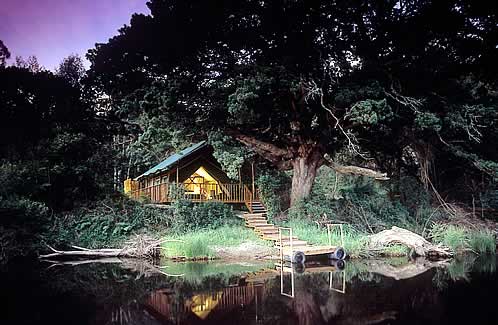
Luxurious tented suites are situated right beside the river.
Jacques tells me in lightly accented English that the rainy reason -- winter in this part of the Cape -- has just ended, and they've had no rain. I ask him about the rugby; will I be able to watch it in my room, will we be in time for the start of the game? He tells me there are no televisions in the tented suites. For a moment I feel myself bristling with irritation. We city slickers are used to convenience, especially our home comforts, aren't we?
But Jacques' good nature is infectious, and it gets the better of me. He says there is a big wedding on the deck, and they'll make a plan so that I can watch the game on the big screen in the conference room.
African Ethos
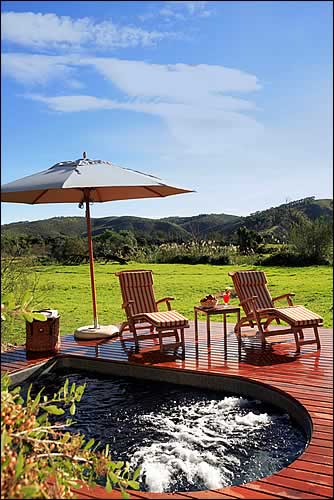
When I arrive the decor takes me into Africa. There's thatch, skins, ostrich shells on wrought-iron chandeliers, themed deckchairs and wide light-khaki umbrellas holding off the African sun. All very tastefully and thoughtfully put together. There's a view toward the high purple Outeniqua, a river sprinkled with stars directly below.
Yes, the African ethos is immediately apparent, and to begin with, for a few minutes I completely forget about the rugby game. When I finally settle down to watch, the Tongans give the South Africans a huge run for their money. Somehow we win, but after the game I'm feeling wound up once more. Maybe TV isn't such a good idea, I'm thinking, sipping cool, dry white wine.
On cue a ranger emerges and offers to take me to my suite. My bags are already there he says. We drive down to the Moordkuil river -- so named because a large number of Bushman were rumored to have been killed here -- a blue crane stands between the parked cars, like a very strict parking attendant.
Riverside Tents
We step onto a boat and hum around a bend toward the wooden jetty on the other side. Those few moments on the river, the gurgle and flow of the river continue nature's gentle washing of tired feet and ruffled feathers. I follow the wooden path between the thick green stems of a Cape Ash, and there it is. I'm number 15, Byevanger (Bee Catcher). The Bushmen would have enjoyed that.
I'm perched a few meters directly above the shining river, with forest hugging me on every side. I step across the wooden deck and into the tent. Inside, the floor is pine. There's a big four-poster bed softened with mosquito nets, tastefully arranged wicker chairs -- leather-bound -- and rustic metal lamps giving off a warm golden glow. There are skins on the floor.
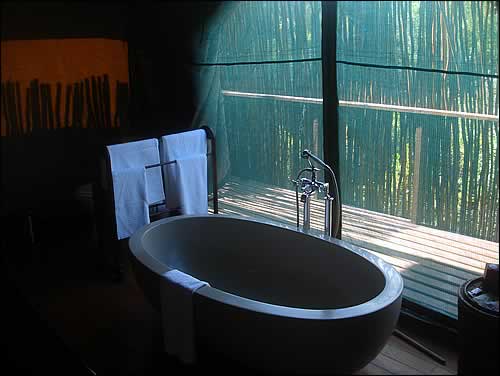
Soak up the sounds and scenery. Taking a bath is just one way to connect to the outside world.
Behind the bed is a nice little nook: a solid giant earthenware cauldron is a bath, Eartherapy toiletries on hand for all sorts of bath time pampering and a refrigerator stocked with everything you might need. You can order room service for those incidental necessities; otherwise candles and heaters provide the finishing touches for a perfectly natural atmosphere.
Au Natural
And that's what it is. All natural. It's the sounds you see that permeate the walls of your riverine abode that are one of the absolute highlights. While in the bath (the water is clean and piping hot) I hear the twitter of birds then, that most African of sounds, the sharp cry of the fish eagle. It's a delight to be so close, so connected to nature. As darkness folds around me, lions roar and an elephant bellows.
Now it's time for the crickets to join the nocturnal symphony. They sing. They sound like really happy crickets. In nature, you know, there is no such thing as noise. There are just sounds, and they do soothe. It washes over me, and the cactus begins to soften. The barbs turn into buds. I get out of the bath suddenly hungry. As I'm getting dressed I get a call: "What drinks would I like served at the Boma?" I put down the phone. I feel like singing with the crickets. The 40-strong staff has thought of everything.
Magical
The rest of the Botlierskop experience is gentle and magical. Whether you eat in the Fireplace Restaurant or the Boma lower down, expect a feast, and a feast of wild meat in particular. You'll have a choice between zebra, kudu, ostrich, warthog, crocodile -- the list goes on. Try to save some space for dessert. The food really is so good it's difficult not to stuff oneself.
You can do a game drive first thing in the morning. Because I slept so well -- the best sleep in months -- I went on the second drive, at 10 a.m. The cold front had already passed over us, so I was glad for the later, warmer start. The tent was cozy since they have electric blankets and heaters in all 19 suites.
Game Drive
Early on the drive we see impala (including the rare black impala) near the owners' residence, white rhino, zebra between the neon-green sunshine cone bushes, giraffe, wildebeest, waterbuck (some people called them kringgatte), bontebok and the most elegant antelope of all, the regal eland.
The eland features a great deal in Bushmen rock art, and it's not difficult to understand why. It is massive, yet it can clear 2-meter-high fences like the kudu. They survive seemingly without effort, and because they draw moisture out of plants and leaves they never have to drink water. The guides are knowledgeable and nice; their enthusiasm about the environment is matched by their warmth to visitors.
The cigarette bush is pollinated by one bird that has a specially adapted (curved) beak in the same shape as the flowers.
Higher up on the plateau, our ranger points out the cigarette plant, a flower that requires a specialized tool to extract nectar. Only the orange-breasted sugarbird has the curvature right, and so only these birds can pollinate cigarette bushes. As we climb up the saddle, we see the sea and Mossel Bay, its tiny matchbox buildings colorful in the distance.
Our guide shows us the extent of a devastating fire: on one side of the fence thick fynbos, on the other side, short, stunted grass. The advantage is that it is easier to see the wildlife where the grass is shorter. The game drive ends with a visit to a small pride of four lions, and some impressive vistas over the Botlierskop valley.
Helicopter
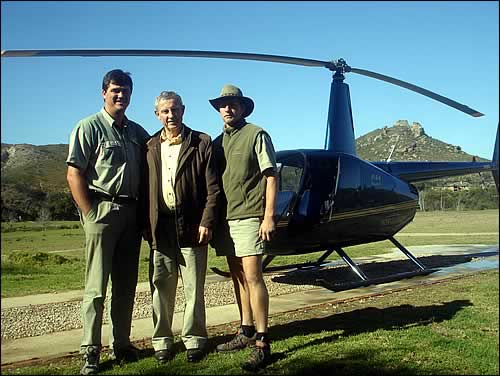
Arnold, Dirk and John, standing in front of the Raven helicopter.
Guests who stay two days or longer may make use of the helicopter on the premises, a Raven II. Flights are around 8 a.m., and the owner's son, Arnold Neethling, is your pilot. I was privileged to fly with Arnold, his veterinarian father, Dr. Dirk Neethling, and John Lee, a ranger at Botlierskop. Dr. Neethling tells me: "Bewaarders moet benutters wees" ("Conservers must also utilize").
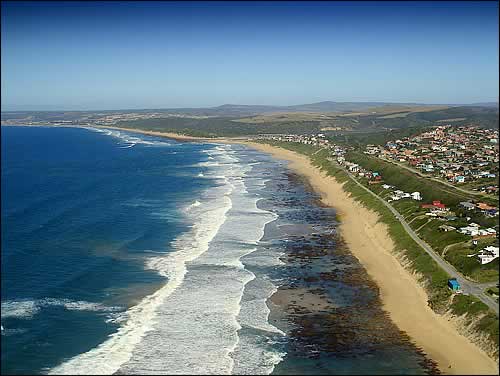
Dr. Neethling pioneered the breeding of the black impala, and it's thanks to his success with them that he was able to develop Botlierskop into the large-scale success it is today. We flew over the reserve, and then looked beyond, to the seascapes around the Klein Brak River. Helicopter flight is of course totally different to flying in an airplane. There's something faintly God-like in the ability to position yourself in the air wherever you mean to be.
View toward Klein Brak River, a stone's throw from the Botkierskop Reserve.
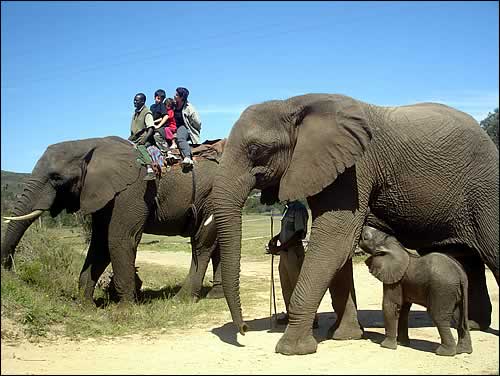
The highlight of a visit to Botlierskop is still to come though. While elephant rides on the movie stars Sam and Tsotsi are a treat, the elephant picnic is even more so. A nice light lunch is served on crisp linen-covered tables out in the open, beside the cool of a large tree and the river sliding by below. You can choose to drink wine, champagne, whatever you want with your meal. Once done, guides bring Tsotsi and the adorable months-old baby elephant, Shimba into the clearing.
Riding the elehants is one of the highlights at Botlierskop.
If you hear a rumble in the jungle, it's one of the big elephants saying, "I'm hungry, let's get on with feeding time." Don't miss the brilliant photo opportunity that follows. Guests have a chance to stand beside an adult elephant and feed it apples by hand. First you offer an apple to the trunk, then, with a hand holding the tusk (Tsotsi only has one), you say, "Up, up, up!" She raises her trunk and opens her mouth, exposing a large, triangular, soft (and I can confirm slimy!) pink tongue.
Put the apple on the tongue and make sure someone is there to capture the moment. It's a test of mettle. A little girl was too terrified to do it. I laughed seeing how nervous some of the men were, placing their apples in the elephant's mouth, and then pulling back quickly in terror.
The elephants are exceedingly gentle, and your commune with them is likely to be the closest you will get to these gentle and intelligent animals. It's likely to be the most delightful of your experiences at Botlierskop.
First People
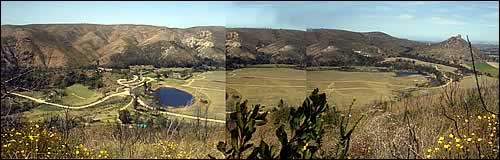
The Bushmen chose the Botlierskop Valley as their hunting ground. They had good reasons. It is a giver and restorer of life. Even after fires and floods, the valley still teems with life, from its fynbos and flowers, to the large idiosyncratic animals you'll find all over the reserve.
Before I leave, I climb Botlierskop with John Lee -- an interesting fellow and part-time hunter -- who first discovered Bushman paintings near the summit of the peak.
Standing in the cave, flint stones in my hands, the whorls of my fingers moving over the soft ochre stains, I feel myself moved to the moment when these first people were here, clicking softly in the firelight and hiding from the people who would come in an endless tide in their ships. John and I decide the Bushmen chose this cave as a lookout and a hideaway.
I believe they were happy here, while they lived in this place. They found the full moon, and honey, and a short-term safety from the dangers beyond the valley. When you go, let go of television and the Internet and you will discover the same elixir, like a soft rain falling on dry soil.
It rained on my second day at Botlierskop. I listened to the sounds. I reached out to the animals. The dry soil softened, and I came away fully restored. It seems to me that the way to connect with nature is to find those places specially chosen by the Bushmen in this country. The Bushmen chose places that could look after them. Botlierskop is just such a place.
Injuries in pro cycling average out to around five serious injuries per week among the four hundred or so professional cyclists. During a six-month season, that amounts to a one-in-four chance that they'll log hospital time. That’s more attrition than you’ll find in an international rugby team. The average NASCAR season has even fewer injuries, perhaps five serious injuries all year.* But you don’t have to be a professional cyclist to run the risk of a serious injury. If you’re regularly riding on the roads you’ll need to know what to do when it happens– by Nick van der Leek
There’s a reason for our rituals; for our good luck charms. Riders and coaches will do almost anything to feel safer, to be able to ride with less fear. Even so cyclists make mistakes. Sometimes we’re arrogant and those ‘mistakes’ are intentional, it comes from cheeky riding. Let’s face it, there’s an exuberance and enthusiasm that comes from exerting our will on an uncaring world; this sometimes makes us brash and reckless.
Motorists sometimes mis-interpret why cyclists don’t stop at intersections. I’m not condoning it, but I’d like to offer an explanation. The reason is that the cleat, fixed to the shoe, is almost like a key that fits into a lock [in the pedal]. You can imagine, not being able to see the keyhole, it can get tricky to maneuver the cleat into a specific space. But every time a rider stops, he or she has to unclick both feet. When a rider pushes off there’s a tricky moment where the rider must try to find the pedal and click into it. Remember this is a blind process, the rider must feel his way, and many amateur riders fall either because they can’t get their feet in or out of their pedals. And it’s for these reasons that cyclists try to avoid having to stop altogether, if they possibly can.
Some years ago I was cruising down Bloemfontein’s biggest hill, down Harrismith Road, and a third of the way down I saw the traffic light blink red. I decided I wasn’t going to go through the rigmarole of stopping. So I went through the intersection – without slowing down – and then a car immediately ahead of me turned left into a driveway and I because I was flying down I couldn’t stop. I hit the passenger door and flew, in a somersault, over the bonnet. I landed and rolled in one movement and stood up without a scratch. My bicycle was fine, front wheel alignment slightly out, but not enough to preventing me from completing the day’s training. The driver, shocked, feeling responsible [unaware that I had gone through the red light] assured me he would pay for repairs the dent to his front door. I cycled away feeling like Superman.
For every story like that there are a handful of stories about arrogant or aggressive drivers, and usually the cyclists come off second best, often dead [see below] with their bicycle frames in pieces. This article doesn’t intend to lay blame in either case – but I’m sure we can all agree that being on the road, whether in a car or on a bike, is dangerous.
What a lot of cyclists don’t realize – and probably don’t like to think about – is just how dangerous the sport is, and how easily freak accidents happen when you’re riding on less than an inch of rubber touching the road. And when a serious accident does happen, what should the accompanying peloton do?
When I started out cycling, this is around twenty years ago, I encountered a rider with massive cuts in his face, to his lips and tongue. What had happened was due to a manufacturers fault. The frame’s fork [supporting the handlebars] had snapped. The rider – a skilled cyclist - was doing criteriums and without warning fell face first into the pavement. That’s not something you can prepare for other than to have your frame X-rayed. The point is that accidents happen and because they do, it always pays to be extra-cautious.
What I am about to tell you is a true story that happened on the morning of December 8th, a Tuesday. I joined a large bunch of the Illovo Riders as they turned into Hope Road, at around 5:15am. Around thirty of us negotiated Hope Roads speedbumps and avoided the occasional potholes and a few kilometers later, we were freewheeling down the smooth and straight [and obstacle free] Club Street. On our left was the foliage and greenery of the Huddle Park Golf Club, while on our right, the suburbs of Linksfield were still sleeping.
We were freewheeling at 48.8km/h. This was unusual – we often motored down this section at a heady 55-65km/h. But since all the major races were behind us, we were in a relaxed mood, a pre-holiday buzz. It was due to this slower speed that two riders moved forward. One of them, a strong rider originally from the Free State, Barry Burger**, stood up and as he did, his foot slipped off his pedal. This happened so suddenly and unexpectedly that Barry lost control of his handlebars and from the standing position fell onto the road, face first.
From where I was, 10-15 metres back, I saw the sudden bottlenecking of riders, and sparks fly as Barry’s bicycle pedals scratched against the tar. Within 2 or 3 seconds I was beside him, having seen another rider go straight over the top of him and falling, but at a much reduced speed. The entire peloton pulled over. Fortunately we had a safety vehicle escorting us – the Yaris idled in the road, emergencies on, providing protection against traffic coming in from the rear.
It was immediately obvious that it was a very serious fall. For starters, Barry wasn’t moving. Also, the position of his body, head against the road, body facing flat against the road, and hands and arms at the side of his body. I immediately pulled out my phone and said we should call an ambulance. Someone else beat me to it. The next thing we noticed was thick tomato sauce red blood on the road surface around his head. The leader of our group, Jeremy Maccelari, kneeled over Barry. One of the lady riders, seeing what we’d all seen, started sobbing.
Someone removed Barry’s bicycle and loaded it into the hovering Yaris.
Given the obvious seriousness of the injuries, time now moved agonisingly slowly. Barry remained motionless, Jeremy spoke to him but there was no response. A few riders went on ahead to slow traffic approaching in the opposite direction, others directed traffic around the accident scene. After around a minute Barry’s breathing became audible. A horrible, gurgling, almost snoring noise. It was clear that the haemorrhage he’d suffered was interfering with respiration.
I suggested that we turn Barry onto his back since he was lying on his lungs, causing his body to heave more and more with each breath. But the risk was, if he had suffered damage to his neck or skull, that movement could aggravate this. Also, by leaving him face down, the blood was more likely to exit the body than flow into his mouth and lungs, something that was already happening.
I warned that if the wheezing stopped we’d have to immediately begin CPR. The next few minutes were brutal. Barry’s breathing became more labored, and finally he made small ineffectual movements of his arms and legs. Jeremy spoke to him throughout, trying to keep him still. Barry did not seem to be fully conscious. By the fifth minute Barry had turned himself slightly, so that he was lying more on his side. Jeremy kept a hand on him, saying his name and encouraging him to lie still, reassuring him that help was on the way.
The ambulance arrived and the paramedic walked calmly to where Barry was lying, by now the patch of blood was about two square feet, and we could see obvious damage to his face around his eye, directly below the helmet. The paramedic didn’t run around in a panic. His movements were careful and considered. After a brief examination Barry was turned onto his back, his helmet straps cut and the helmet removed, and a transparent oxygen mask slipped over his mouth. I noticed a thin red line of blood erupt from his mouth and flow down his cheek.
His cycle shirt was also removed to check for injuries to his torso – there didn’t seem to be any. Two or three riders then assisted in loading Barry onto a stretcher, and during this time his phone was used to contact his wife and inform her which hospital he was going to.
While one of the riders in our group – Allan – is a doctor, Jeremy supervised the entire process and Allan had no problems with what we were doing or how we were doing it.
After the ambulance left a subdued group turned around and cycled back the way we had come. Since that day it is difficult to get on the bike and not have flashbacks. The trick is to be aware of the dangers and how easily they can happen, to be prepared, but not to be overcome with fear. The trick is a balance then of preparation and alertness.
The Aftermath
I called Barry’s phone later that day; his wife answered. She sounded concerned, but not distraught. Barry had been induced in a coma, and was on a ventilator. He had suffered a fractured eye socket, a broken jawbone and broken nose. The concern was brain damage, and unfortunately it was later ascertained he had some bruising to the brain and small internal ruptures in the brain. A week later Barry ‘came to’ but has remained under heavy sedation and is still on a ventilator. Progress is slow.
Lessons Learned
Although injuries are by their very nature idiosyncratic, these general rules apply:
-Have your phone with you on all rides
-Call an ambulance immediately [make sure you know the numbers of hospitals in your area]
-don’t move or interfere with the body [if the rider is unconscious]
-have one person attend to the fallen rider
-observe the injuries without touching them
-be vigilant and try to gather as much information which can then be conveyed to paramedics. If possible try to convey this information to the paramedics whilst they’re en route
-secure the area [both sides of the road]
-don’t forget the bicycle [get it out of the road, organise for someone to collect it]
-call the cyclist’s family
-assist the paramedic where necessary
This particular accident happened as a result of a cleat slipping out of a pedal. Check yours. Check your frame for signs of cracks, warping or rust.
Prevention
-check your equipment [for rust, for wear and tear]
-service your bicycle every 3-6 months
-try to arrange a support vehicle for road training [otherwise ride with bigger, organised groups or clubs that do make these arrangements on a regular basis]
-stay alert and cycle defensively
-as far as possible, when in a tight knit group, don’t make any sudden movements.
Note: In my original article this paragraph [below] was left out. Instead of ending on a downer ['progress is slow.' I wanted to end with a bit of perspective. Hence 'Now go out there and have fun.']
The guys in our group have observed that we have ridden literally thousands of kilometres together since the last crash. This crash happened not due to a touch of wheels, or a pothole, or due to traffic but was entirely a freak accident. It can happen. Check your equipment and stay alert to your environment and fellow riders. Now go out there and have fun.
*From Daniel Coyle’s book Tour de Force, on Lance Armstrong.
Nick van der Leek probes for a Wolf under the Hood of South Africa’s A-List Director, and discovers there are hidden dreams and primal drives that lie dormant in every man.
What on Earth possessed Gavin Hood to get involved in the savagely challenging business of rendering a character as dear to the bleeding hearts of comic book fanboys as Wolverine? Wolverine’s impact on pop culture is profound – ranked #1 for Wizard magazine’s “Top 200 Comic Book Characters of All Time” and #4 in Empire Magazine’s “50 Greatest Comic Book Characters.” Wolverine, in other words, is a badass; it takes guts to mess with this guy. CanGavin Hood deliver the animal?
If you’re reading this you probably know by now that he did, that he has. Having seen the flick twice I am impressed. Hood delivers on the whole package: a tight cohesive script, a super cast, explosive and riveting action, beautiful outdoor sequences and a story that connects to audiences in a deep way. Origins also introduces fresh blood that includes Logan’s brother Sabretooth, suffering from a chronic case of bloodlust (Liev Schreiber in outstanding form), and the much anticipated Gambit (Taylor Kitsch), who comes loaded with all the signature moves of a man able to charge matter with volatile kinetic energy and then blow stuff to pieces. There’s more besides in Origins – guy stuff like wars, motorbikes, log cabins, sibling rivalry, various fighting units, teams and squads – but the story is really about two brothers and their desire to, quoting Schreiber, “find their place in the world – to belong to something.” It’s an inner struggle just about everyone goes through at some point and explains why the Wolverine character has such a grip on the collective psyche.
Ok so Origins does the job and Gavin Hood can make big rumble-your-gut flicks, but what makes him tick? At this level of filmmaking mistakes are bludgeoned. How has Hood sidestepped all that? Clearly Gavin Hood has deftly raised his game – I want to know how he did it.
It’s an early Monday afternoon in Johannesburg when we meet for the first time. Gavin Hood is dressed in dark blue, and is a taller, more solid man than I imagined. There’s a well-groomed intensity about him and a charisma that explains why Hood has been in front of the camera too, and has that distinctive, almost magical energy that Hollywood A-listers always seem to have. As we climb the steps towards the lounge for our interview I ask him, conversationally, about jet lag.
“I’m still feeling it, thanks for asking!” his well enunciated English comes out with a gusto that somehow contradicts what he has just said. But the contradiction, if there is one, is the first clue as to why Gavin Hood is not only likable, but has the powerful faculties that high level cinema demands. Hugh Jackman guessed right when he chose Gavin Hood to do the grueling Origins project. Gavin Hood’s success formula can be summarized in 10 points.
1. Keep it simple/who am I?
The Wolverine mythos is neither simple nor easy. Aftyer a shaky start, Wolverine has come to dominate the X-Men, growing more and more popular in step with becoming an ever more powerful, virtually indestructible character in each successive incarnation.
Interestingly when Jackman was offered the role for the first time (and at the last moment) it was not his familiarity with the character but the opposite (will this obscure character that I’ve never heard of work, and be good for my career) that gave him second thoughts. Now Jackman says: “…If I had known I probably would have thought the role was too much pressure – and too much to live up to.
Gavin Hood didn’t suffer similar vertigo, at least, not ostensibly. It all started with a phone call. Hugh Jackman called Gavin Hood because he liked the level of emotional attachment Hood was able to achieve in Tsotsi.
“[He] was at war with himself, just like Wolverine is,” Jackman has said. “I got carried away by Tsotsi’s journey, and by Gavin’s instinct for character and story.”
The first step for the Wolverine (and anyone working on the character), Gavin tells me, is to find out who is, because not even Logan (Wolverine) is clear on that, and he is caught in a constant struggle to first find himself and then keep himself on an even keel. For that you have to go with your gut, your instincts. And Wolverine tends to do that since he cannot rely even on his own memories. Murky may be a good word to describe his past, but a man who has been alive for over 150 years, survived wars and is essentially the King of Pain is always going to be a tough nut to crack.
The brooding, tough as nails Wolverine is difficult to kill because he has had an indestructible substance, Adamantium, forcibly fused into his musculo-skeletal tissue, an excruciating procedure that he was only able to survive by virtue of his healing power. This healing power explains his slow aging process (Logan was born in the late 1800’s to wealthy Canadian plantation owners and today still looks like a guy in his late thirties in peak condition.).
But while Logan can heal almost immediately from vicious traumas, he can’t suppress the pain of those experiences. Even his hands do not have natural openings for his saber-like claws, and each time they extrude (in tune with a rising, burning rage) they slice through his skin. With all this mythos to master, I wonder how Gavin Hood went about putting this crazy-complicated puzzle together coherently.
“Mum and dad raised me around theatre and Greek mythology. We joke about it now,” Gavin smiles, “but those myths were really about the first superheroes. Zeus with his lightning bolts and Poseidon conjuring up storms,” –Hood’s hands dance with spider like expression between us –“What are they? I approached the mythic Wolverine in the same way. Who is he? Is he a guy with claws or is he a guy with profoundly human emotions that manifest because of his massive rage? And what made those Greek myths so exciting for audiences were 2 things: firstly they were larger than life, but secondly (and more importantly) their disputes were profoundly human. They had issues with their lovers and their brothers and their wives and their sons. These are still human stories told in an exciting, operatic way. And I think what Wolverine is, and what Hugh Jackman represents in Wolverine is exactly that; a modern mythic character that is driven by profoundly human emotions.”
The first piece of the puzzle is to break it down to one’s own context and then to distill it into the simplest terms. For Jackman his mandate to Gavin Hood was simply: “Exceed expectations.” The first step doesn’t have to be more complicated than it needs to be.
2. Manifest Yourself/staying Focused
Wolverine's catch phrase is: "I'm the best there is at what I do, but what I do isn't very nice."
Knowing what you do and that you can do it is the next step. I’m intrigued when I discover that Gavin Hood’s trip to becoming a movie director echoes to some point Wolverine’s foggy discoveries about himself. It is one thing to know what one does, quite another to understand what that means and what needs to be done maintaining that belief. Lance Armstrong is a manifestation of this in the cycling world. When the stakes are this high self doubt can become overwhelming.
Gavin says he didn’t start out making movies, in fact he admits there was no Damascus experience where he decided that was what he was going to do. It was a process.
It is also interesting to note that while Gavin Hood and Hugh Jackman succeeded in bringing the essence of the Wolverine backstory and mythos to the silver screen, they were also prepared to manifest a few changes that they believed suited Logan’s evolution. Two examples are firstly that Logan seems to have a fear of flying when the comic books represent him as a pilot, and secondly that when those claws extrude they do so apparently without pain (in other words, they don’t cut through his skin).
Beyond self belief is having the courage to make some changes, which is something like getting a license, and what are licenses for except permission to go out and do something, usually something risky like buy a gun, or fly a plane.
3. A License to Dream/finding a way through bad memories
When I ask Gavin Hood to tell me about the movies that influenced him I expect him to mention Highlander [swords, decapitations, healing power, living beyond a sell-by date]. Gavin Hood says the first movie that really inspired him was the South African production of eLollipop. “I remember defining moments on the path to me finally being brave enough to do what I really wanted to do… but didn’t think that we were allowed to – could do – from South Africa. Making movies seemed like something that people from overseas did. But it was seeing, for the first time, when I was 12 years old, eLollopop. It was the first time I ever saw a South African film.”
Hood hands grip the sofa mimicking himself in situ. “I remember sitting in my seat going, ‘Wow, these people talk like me, sound like me, this is a story about us and people in our country… Up until that point all the movies I’d seen were set in America and in England. So that stayed with me. And I’d love to say that was the deciding moment but it wasn’t. I got involved in plays at school, but when I went to university there wasn’t much of a local film industry, so I became a lawyer. But I also studied theatre while I was doing law, and was also doing a lot of stills photography which was another passion I got from my dad. So I had this passion for drama and this passion for photography and so it finally dawned on me that I really wanted to be a filmmaker but I was too afraid to say so, because I didn’t think it was really possible. Eventually I went to study film when I was 29, and I sold everything in order to commit to this. And then there were many years when I thought I’d made a mistake because it was really tough, and I thought ‘Maybe I should go back to law’.
When you made your decision to study film did you also make a geographic shift?
“Yes, because for me I was starting over and when you do that sometimes it’s good to be away from the world where you grew up.”
4. Hero on a Quest/ must leave the nest
Origins starts off with two young brothers who have a traumatic experience and are immediately propelled out of the nest, the safety of home. This is a recipe for great trauma, but also for great adventure and of course, growth.
“The classic story is when the hero leaves the home and goes to another world, has all kinds of adventures and then comes home. Nobody gets a particular amount of life experience by staying too close to the nest.”
It goes without saying of course that ‘leaving the nest’ doesn’t have to happen once or twice in your life. Every time you give yourself permission (or find yourself hurled into) the next quest, be it by losing one’s job or applying for a new one, you leave a set of familiar circumstances. It’s the only way we grow.
5. Be brave/Use your skills
In an odd sense the character in Origins is probably the most restless of all the mutants – never quite satisfied with who he is and how things are, but determined to take a stand nonetheless. He is galvanized by the past and hellbent on venting himself on the world. Similarly what Gavin Hood has done is that he has bravely stuck to his guns, debuting with the 35mm 22 minute short film called “The Storekeeper” in 1998. The film won thirteen international film festival awards, one of which qualified Storekeeper for Academy Award consideration in the same year. Gavin then wrote, directed, co-produced and starred in “A Reasonable Man”. In 2001 All Africa Film voted Hood best director, best screenwriter and best actor and Variety named Hood one of their ten directors to watch at the Sundance Film Festival. Hood’s adaptation for a Polish children’s adventure story – set in Africa – became the highest grossing movie in Poland in 2001. After Tsotsi Hood directed Reese Witherspoon, Meryl Streep and Jake Gyllenhaal in Rendition, a film about US anti-terrorism laws allowing detention without trial. The courage of this period was rewarded with Jackman’s offer: “Make Wolverine with me.”
5. Beyond the language barrier/universal languages
Wolverine is a character that is always trying to figure out who he is and where he came from. The answers lead to even more questions. Don’t be afraid to face those inner monsters. Face up to it because there are treasures there in those thorny thickets that can save us from repeating past pain and deliver us to our true potential. Reality. The sooner we go through this prickly process and sooner we get on track to being effective in what we’re truly meant to be doing.
On at least two occasions the cinematography in Origins alludes to the fog, the smoky uncertainty that Logan’s long life and amnesia have conspired to create. Even keen animal senses are no substitute for lost memories and uncertainty, but one thing that is definite is that the human condition – and especially our uncertainty – is universal. Knowing this makes it easier to understand both ourselves and others.
How, I ask, spinning my pen in the air, did you go about making movies across so many cultures and in so many languages? “For me I’m always trying to get to the emotions, that look in the eye that lies underneath lines. A line is always floating on something. That’s what’s important. Not what’s being said. We find that audiences respond not so much to what we say but how it’s said. It’s all about tone of voice and body language in this business.” To demonstrate the point he asks me, with a congenial grin: “How are you?” Then he folds his arms dramatically, sits back in his seat and with a low voice, and hooded stare, says, “How are you?”
Gavin Hood has learned to polish and articulate himself to Hollywood. When you can articulate what you’re trying to do, it shows you have a clear idea of who you are, where you’re going and provides some clarity on how realistic your chances are of realizing not only your own objectives, but those entrusted to you.
6. Understanding Inner Conflict/ Trauma changes us
Trauma. It can lead to growth, stagnation, mutation or decay. The Mutant gene is symbolic for that change which may be either constructive, or destructive, or both. But whatever happens we still have to manage that process.
“I’m much more interested in stories that acknowledge our own capacity for…” (his eyes bulge for emphasis) “evil, if you like. Or doing unpleasant things. And we have to monitor that within ourselves. I think human beings are more complicated. If there is a parallel between Tsotsi and Wolverine both of these characters have an inner conflict about whether they even like their own nature. And it’s that struggle for their better nature to come forth that they have in common. And certainly, ironically, that’s what Hugh Jackman loved about Tsotsi, and why he asked me to do the movie.”
After cracking a joke (Gavin Hood is an entertaining mixture of drama, levity and seriousness), he says, “I want to thank Hugh Jackman for his recognizing that maybe I could bring that inner struggle out, because that’s the reason you make a movie. You’ve got to make sure it’s packaged with great special effects, but special effects alone won’t hold an audience. What holds an audience is still that old-fashioned thing of do we sense some affinity with the character. And that affinity is usually because most of us, at times, aren’t sure we like ourselves.”
The same is true in life. Be yourself, but get a load of liking and embracing all of who you are. Don’t fight it and don’t deny it. If you like yourself, and you’re honest about that deal, there’s a good chance other people will embrace you and your ideas as well.
7. The Weight of Expectation/don’t rip yourself off
“On every film that you make there are expectations. There’s the excitement of it coming out and the fear that you may have screwed it up and you hope like hell that you can keep working. Because I love what I do but you really do exist job to job.”
I tell him about a man who pulled out a pirated copy of X-Men Origins on William Nicol Road on my way to the interview. Only the most anticipated movies that get this sort of treatment and so the weight of expectation, even when it seems to manifest in a negative way, any time someone is breathlessly anticipating something you’re doing, it’s a compliment. Remember that when you’re stressing about the pressure to deliver.
Hugh Jackman offers a different perspective. Get in character. “I lift twenty percent harder, heavier and longer as Wolverine, than if I train as myself,” Jackman explains with a grin. And Jackman’s ethic rubbed off on co-star Liev Schreiber who gained 40 pounds of muscle for his role.
8. Money Matters/do the job properly
How do you work with millions that belong to other people?
“Well in a sense I’m working with their money and, whether they know it or not, they’re working with my money. If this is a failure for me I won’t have money in the future. So both of us have the same financial risk riding on this. A lot of people say, ‘Well they have a lot of money’ and I say, Well, hang on a minute. If it fails and I don’t get to work I can’t pay for my kids to go to school either. I try to worry not about money so much as just trying to make a good film. For me, for them, for everybody. And that’s a pressure.”
You’re responsible for what you do and what you represent on behalf of someone else, or your company.
Imagine it’s your own money because at the end of the day, everything you do is either a step towards or away from another project.
9. Balancing Act/stay grounded
Delivering an idea – a concept – on target in the face of effusive praise and scathing criticism may be the hardest part. You scale the dizzy heights. The media sing songs of praise. It’s easy to get over-confident and lose the plot. I remind him that he’s won a Men’s Health Best Man award.
“The nominees were very thin that year…” he says, then laughs. Beyond having a sense of humor, how do you keep your wits?
“I like the praise,” he chuckles. “Criticism…is inevitable in what we do,” he says cautiously. “Sometimes it hurts like hell, sometimes it’s illuminating. Sometimes they’re right and you’ve got to say, ‘Wow, I didn’t do that as well as I could have and maybe I can do better next time.’ What helped tremendously was that I was lucky to be working with a leading man who is truly one of the nicest guys [Hugh Jackman] in this business. And I think what we have in common coming from the Southern Hemisphere is that we’re quite down to earth, and don’t take ourselves too seriously. And,” Gavin says, “he’s a very hard working guy.”
Jackman was the producer in Wolverine and made no bones about putting Jackman the actor through some rigorous training. In Origins Jackman says he managed to get himself looking the part of Logan. He felt he’d never quite nailed it in previous incarnations. “For this one,” Jackman has said, “I wanted Logan to look animalistic, veins popping out, and coiled like a spring. I wanted audiences to say, ‘Okay, this guy is frightening; this guy could easily rip someone’s head off.’”
One way to find a balance, to deal with pressure is to work damn hard at getting everything done right.
With a South African directing an Australian, was there any ribbing? Did he enjoy telling an Australian what to do whilst simultaneously they were having their butts kicked in cricket.
“SURE!” he exclaims with a big laugh. “Ja, we kick their asses of course, except after losing the last test I’m sure he will call me and say so.”
Then, with a small open handed wave and starting off in a near whisper, Gavin Hood says, “I’m not sure if I can consciously explain how I deal with pressure. Obviously I felt a lot of pressure on the project and still feel a lot of pressure that the movie will work for the public. I want it to work for the public.” The volume of his voice rises a few notches. “If they like it, it makes me feel good, if they don’t,” he chuckles, “it makes me feel depressed. It is easy to be overwhelmed by the scale of it all. You just have to come back to the place where you say, ‘You know what; I’m still just telling a story about a character that I want people to enjoy.’ And all these wonderful tools that we have at our disposal must be in service to that story, in service to that character. But you know I had a great time working with this scale of visual effects. It was like giving a painter who has been used to working on a tiny piece of canvas a giant canvass and saying to him: wanna throw paint at that? I mean, who wouldn’t!”
Balancing then is really about having an ordered sense of one’s priorities, working with people who have a similar work ethic (people you can work with), coming up with the ability to love what you’re doing and have fun, and at the same time not losing sight of the primary objective.
10. Dig Deep/be brutally honest.
By the end of our interview I’ve come up with a profound truth, and it’s based on interviewing a string of successful people. Almost all of them refer to the impact of their parents. To the schooling and nourishing influence they have had as young children. Almost all of them treat life as an adventure; and they embrace the thrill of being part of that adventure. Becoming who you really are, they recognize, means you can attain tremendous personal power in the world.
You realize watching Origins that the things that are the most painful for Logan aren’t the cuts and bruises. Dealing with one’s own emotions, with the past, with the betrayal of one’s trust, that’s what really cuts him. You’ve got to dig deep to get past all of that.
“Hugh isn’t self-pitying,” Hood says with admiration. “This is all about going on a journey with a character. This guy reaches rock bottom because first one motivation is taken away from him when he loses his lover, and then he discovers his revenge, another motivation – and not a very good one – is taken away as well. Okay, he’s in a mythic landscape, but he’s still a character that you fall in love with. And that’s where I think Hugh does such a great job. He finds all of this inner turmoil. Without being melodramatic. He just is. And I think he’s done an outstanding job.”
With a name like ‘Freeman’, and now practically the same age as Mandela was in 1995, Academy Award Winner Morgan Freeman was destined to play the great man. He’s also played God and Batman’s mechanic, but he doesn’t do accents, and rugby’s not really his game – golf is. Memphis-born Morgan Freeman’s interest in politics comes to some extent from living in the American south. Following a stint as a mechanic in the Air Force, Freeman began his career in the 60’s on the stages of New York City. He visited South Africa and Zimbabwe for the first time in the early 90’s filming The Power of One. After Long Walk to Freedom [Mandela’s life story} proved to be too long for a feature film, Freeman came across a four page treatment written by South African screenwriter, Anthony Peckman. Freeman sent the script to Eastwood and the rest is history.
Text
Nick van der Leek
People are saying you were born to play Nelson Mandela. What do you think about that?
Madiba was once asked who he would want to play him in a movie and he said ‘Morgan Freeman’. When I first met him years ago, I told him I was honored that he had mentioned me to portray him. I was born to act, not sure I was born to play Madiba. But since I did, maybe I was. I don’t foresee me doing it again.
Was it intimidating playing him?
No. The most intimidating part was in the contemplating of playing him. Once you get going you just do it, and hope for the best. The biggest problem I foresaw was sounding like him. Because I don’t do accents. The only accents I can do are southern accents. I’m from Memphis after all.
Was Nelson Mandela’s South African accent difficult?
That was one of my main concerns – getting his accent and the rhythm of how he talks. I’ve heard him speak often, and as we got closer to filming I watched some tapes…and then suddenly I had it. I wanted to avoid acting like him; I needed to be him and that was the biggest challenge.
You’ve been president twice and God twice; how are these roles different?
I’m not quite sure there is a difference between the two. It doesn’t really compare. It’s really no effort to play God. [Pauses] …And there’s a lot effort [involved] to playing Mandela.
With INVICTUS [Latin for ‘unconquered’] you’re involved in making a movie about reconciliation. Is this something you’ve encountered – does this resonate with you personally?
Good question. Interesting. Yes, I must have come to that conclusion sometime in my early years because I’ve always found discrimination distasteful. I grew up in the American South where it was very prevalent. And, you know, you live with what you find yourself with. I was not a cruder, campaigner or a protestor. I wasn’t a revolutionary; I wasn’t that at all. But I found myself needing, as it were, to break loose from such constraints. Because in my case, of course, I was a second class citizen, and I wasn’t cut out to be that.
Did you have a revelation about yourself, playing Madiba?
No. Well, truthfully it may be too soon to tell. I suppose if there was one realization it was that I could do – I could pull off – an accent after all.
How did you prepare for your role as the South African president?
If you’re going to play a role that everybody knows, it behooves you, I think, to do as much research as possible. How do you research playing God? When you meet Mandela you know you are in the presence of greatness, but it is something that just emanates from him. He moves people for the better; that is his calling in life. Some call it the Madiba magic. I’m not sure the magic can be explained. But to play this role I said I would require access. And since 1997 I was able to spend a lot of time with him. [The producer, Lori McCreary commented that herself and Mr. Freeman had visited Mandela – who they described as ‘in high spirits’ – 20 minutes prior to the interview].
How did you go about your research?
I went to see him. I said to him, ‘Madiba, we’ve been working for a long time on this other project [The Long Walk to Freedom], but we’ve just read something [John Carlin’s Playing the Enemy] that we think might get to the core of who you are…’ And Madiba said, ‘Ah, the World Cup.’ Then I knew we were heading in the right direction.’
Was this an easy project?
The entire project was like magnets coming together – right people, right time, right place, right issue. Everything just clicked into place, which doesn’t happen very often. But when it does, it’s like destiny.
And Clint Eastwood – what is it like working with him?
He’s quick; if he’s got it in one take, he’s moving on. I just love that. I also appreciate his quietude, which represents strength and control.
How would did Matt Damon do as Francois Pienaar?
In this job you have to become – physically – another person. He did a wonderful job.
Do you remember where you were during the World Cup?
I probably could if I calculate how old I was. 1995 was fourteen years ago, and I’m 72 now. When I was 58 where was I and what was I doing? I don’t know.
Are you a rugby fan?
No, I’m not a rugby fan as such. But I’m not particularly into sport. I’m not a football fan, baseball fan or a basketball fan. I’m a golf fan. Golf is the only game I can play. I like to swing a stick every once in a while.
Sometimes, you know, I don’t sleep well at night. I might wake up in the middle of the night and I’ll turn on the television and scan through the channels. A few nights ago there was a rugby game on. I watched two minutes and then…I was done.
What sort of changes have you witnessed since you were here doing Power of One?
I came here, and I was in Zimbabwe in 1991 and 1992. The change in South Africa since then – there isn’t really a word to describe it. ‘Dramatic’ has to serve. Amazing change. The country has seen itself in a totally different light. I was here again for Mandela’s 80th birthday; that was 11 years ago. The place was crackling with the electricity of promise. It’s still here, but not as strong in its newness. This country has so much to offer the continent, the world, but especially the continent.
What attracted you to this particular story?
This is an important story about a world-shaking event that too few people know about. I cannot think of any moment in history when a nation coalesced so suddenly and so completely. I was proud to have the opportunity to tell this story. And when you have the chance to tell it with Clint Eastwood’s abilities...it’s something you just have to do.
Where have you traveled in South Africa and Africa?
I’ve been to Alexandria. What a turn off. It’s not a great place for someone of my persuasion. I’ve been to Zimbabwe. I remember once, we had been driving and police stopped us and at one point it appeared we would be arrested and thrown in jail. I recall abject fear. There is a place near here that I like; Sun City.
What sort of legacy would you like to leave?
[Chuckles]. I just want to be liked. Have you thought about that? [No]. So you surmise that I have. Well look, I have thought about it, to be honest, but I haven’t come up with anything. I suppose what I’d want to appear on my…what is it…an epitaph? I like the idea of: ‘Morgan Freeman. The Great Pretender.’
Sport has the power to change the world. It has the power to inspire, it has the power to unite people, in a way that little else does – Nelson Mandela
Mandela’s personal assistant, Zelda la Grange says of INVICTUS and Morgan Freeman’s performance: I know the house so well and they recreated it to perfection. The environment even felt the same. And then I heard Morgan Freeman speak – I didn’t see who it was at first – and I thought, ‘Now how did Mr. Mandela get here?’ I see Madiba almost every day, and that was the closest anyone could ever come to speaking and behaving like him.
Eastwood on Freeman: Morgan is great. I could not imagine anyone else in the role of Mandela. They have the same stature and the same kind of charismatic nature. Morgan also has a similar vocal quality, and he worked very hard to capture Mandela’s inflections. I think he did it quite well.
Author’s note: Freeman’s performance in INVICTUS has already been slated for a Best Actor nomination. He has won an Academy Award for Best Supporting Actor for his role in Clint Eastwood’s Million Dollar Baby, but this could be his first Award for Best Actor. Invictus has also received 3 Golden Globe nominations for best actor [Morgan Freeman], best director [Clint Eastwood] and best supporting actor [Matt Damon].
For more on the writer visit www.nickvanderleek.com


 Six-week-old Shima is the newest addition to the Botlierskop Reserve.